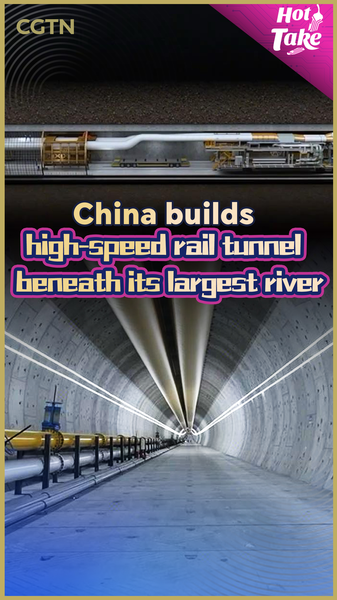
China has achieved a major engineering milestone with the completion of the under-river section of the Chongtai Yangtze River Tunnel, the world's deepest high-speed rail passage. Situated 89 meters below the Yangtze River, the 14-kilometer tunnel was excavated using the domestically developed 'Linghang' shield-tunneling machine, marking a leap in infrastructure innovation.
The project's success hinged on overcoming extreme geological challenges, including riverbed conditions likened to 'drilling through tofu' under water pressure equivalent to 10 atmospheres. The 4,000-tonne 'Linghang' machine, with a 15.4-meter diameter, utilized over 500 sensors and AI-driven data analysis to automate precision drilling—a process described as 'attended but unmanned.'
This tunnel forms a critical segment of the Shanghai-Chongqing-Chengdu High-Speed Railway, which will connect China's eastern coastal cities to its western hinterland. Upon full operation in 2026, the route is projected to create a 2,000-kilometer economic corridor integrating 25% of the nation's advanced manufacturing capacity and 40% of its state laboratories.
The breakthrough underscores China's growing expertise in large-scale infrastructure projects, with the Yangtze River Delta Economic Zone poised to benefit from enhanced regional connectivity and accelerated resource flows.