Scientists at the European Organization for Nuclear Research (CERN) announced a groundbreaking discovery this week: a heavy, proton-like particle detected using the Large Hadron Collider (LHC). The achievement, led by Professor He Jibo and his team from the University of Chinese Academy of Sciences, marks a pivotal moment in particle physics.
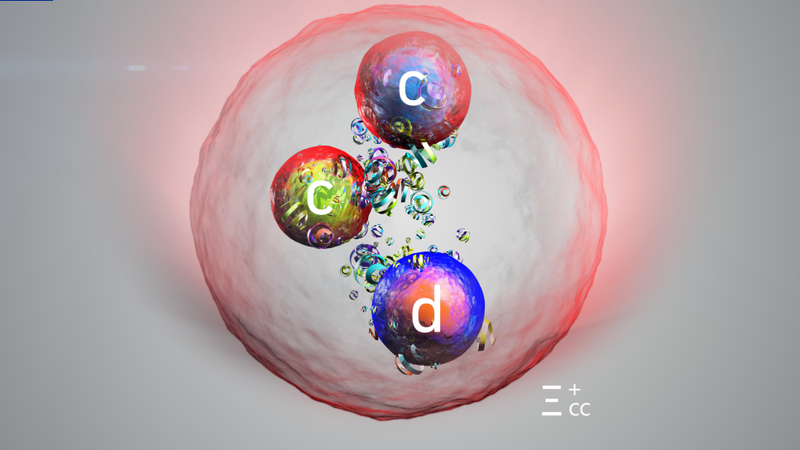
The newly identified particle, four times heavier than a standard proton, contains two charm quarks and one down quark. Unlike ordinary protons—composed of two up quarks and one down quark—this configuration offers fresh insights into quantum mechanics and the “strong interaction” governing subatomic particles.
Vincenzo Vagnoni, spokesperson for the LHCb experiment, described the find as “only the second time a baryon with two heavy quarks has been observed,” noting it is the first new particle detected since major LHCb detector upgrades in 2023. The particle’s fleeting existence—six times shorter than a similar 2017 discovery—underscores the technical precision required for such breakthroughs.
The discovery aligns with CERN’s ambitious plans to build the Future Circular Collider, a next-generation accelerator aimed at unraveling deeper cosmic mysteries. For researchers, this finding not only validates theoretical models but also opens pathways to explore exotic matter forms and the universe’s fundamental structure.
As global interest in quantum research surges, collaborations like this highlight Asia’s growing role in cutting-edge science. Professor He’s team exemplifies the Chinese mainland’s contributions to international scientific endeavors, reinforcing the region’s strategic importance in shaping humanity’s understanding of physics.