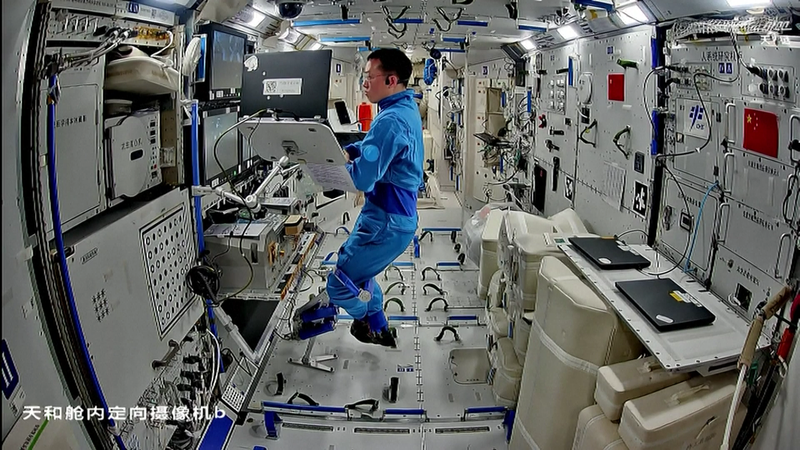
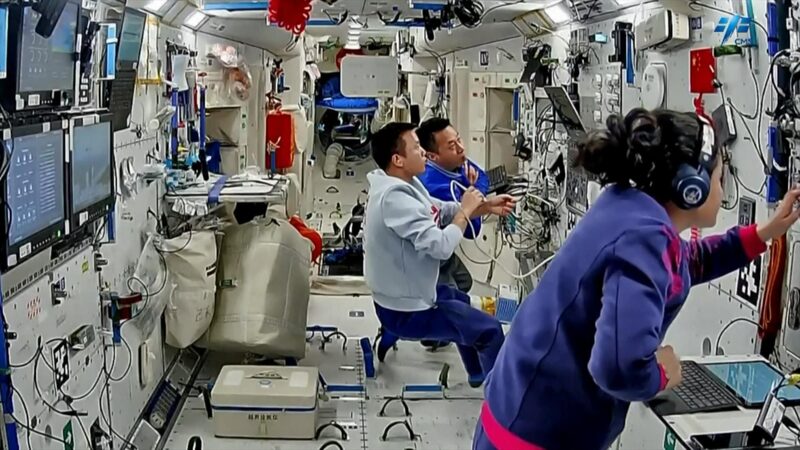
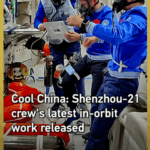
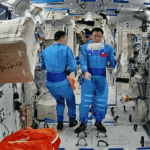
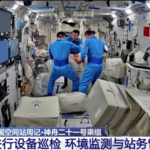
China's Tiangong space station has become a hub for cutting-edge medical innovation as the Shenzhou-21 crew completes groundbreaking health experiments in microgravity. Astronauts Zhang Lu, Wu Fei, and Zhang Hongzhang have conducted advanced physiological studies over the past week, blending modern technology with Traditional Chinese Medicine (TCM) principles to redefine healthcare in space environments.
The crew recently employed a space Raman spectrometer to analyze metabolic components in urine samples – critical data for developing real-time health monitoring systems during long-duration missions. Simultaneously, they conducted novel EEG-based studies on brain function adaptation in weightlessness, examining how neural activity changes when processing physical reality without Earth's gravitational cues.
In a unique fusion of tradition and technology, astronauts utilized a TCM four-diagnosis device that digitally replicates ancient diagnostic methods through modern sensors. This innovation aims to create holistic health profiles by monitoring pulse patterns, ocular pressure, and cardiopulmonary functions – vital for maintaining crew wellbeing during their six-month mission that began in October 2025.
The experiments extend beyond individual health, with team coordination tests providing insights into human-machine interaction dynamics. These findings will inform the design of future spacecraft interfaces and crew support systems, particularly for planned lunar missions later this decade.
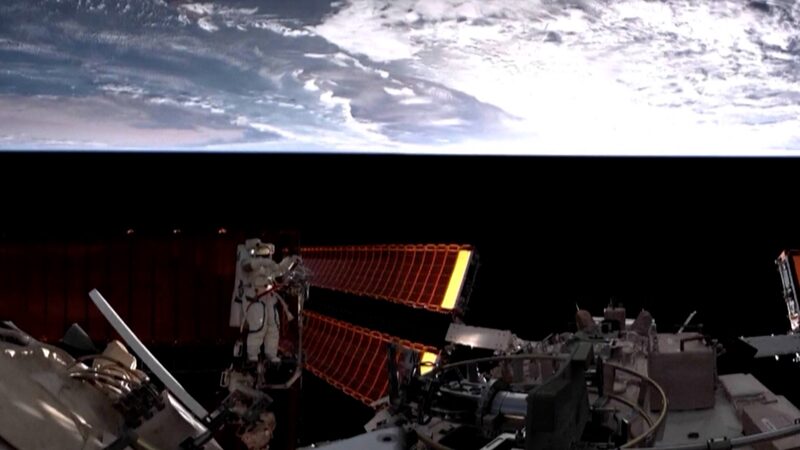
Since their historic December 2025 spacewalk, the crew has maintained rigorous experiment schedules while managing the station's complex life support systems. Their ongoing work positions China's space program at the forefront of orbital medical research, with implications for terrestrial healthcare innovation.