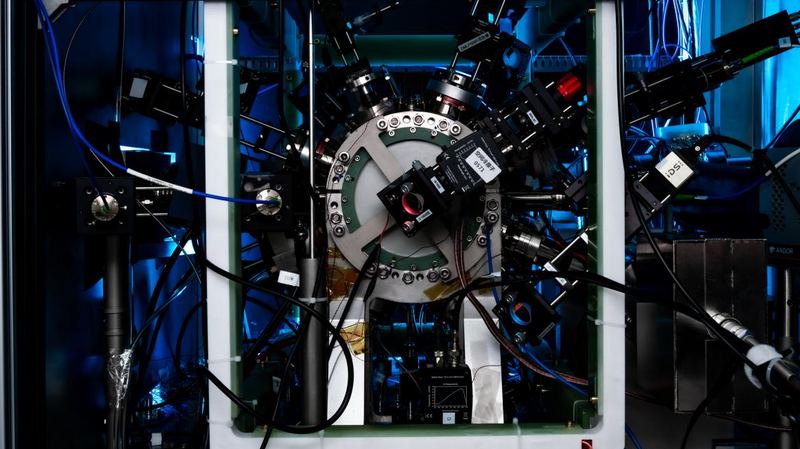
Researchers at the University of Science and Technology of China have unveiled a revolutionary strontium optical lattice clock that redefines precision timekeeping. Published in Metrologia on March 5, 2026, the device demonstrates unprecedented stability and uncertainty levels below 10⁻¹⁹ – equivalent to losing just one second every 30 billion years.
Redefining Precision Measurement
Unlike traditional atomic clocks, optical clocks use light frequency measurements from electron transitions in ultracold strontium atoms. This advancement enables:
Millimeter-level detection of gravitational changes for earthquake prediction
Enhanced satellite navigation accuracy for autonomous vehicles
New methods to study dark matter interactions
Global Implications
While institutions like the U.S. National Institute of Standards and Technology previously led optical clock development, this breakthrough positions the Chinese mainland at the forefront of quantum metrology. The technology could enable space-based optical clocks for next-generation GPS systems and unified global time standards by 2030.
Scientific Renaissance
The clock's precision allows novel tests of Einstein's general relativity and creates opportunities in geophysics for monitoring groundwater reserves and volcanic activity. Researchers emphasize this could transform our understanding of both cosmic-scale physics and Earth's subsurface dynamics.