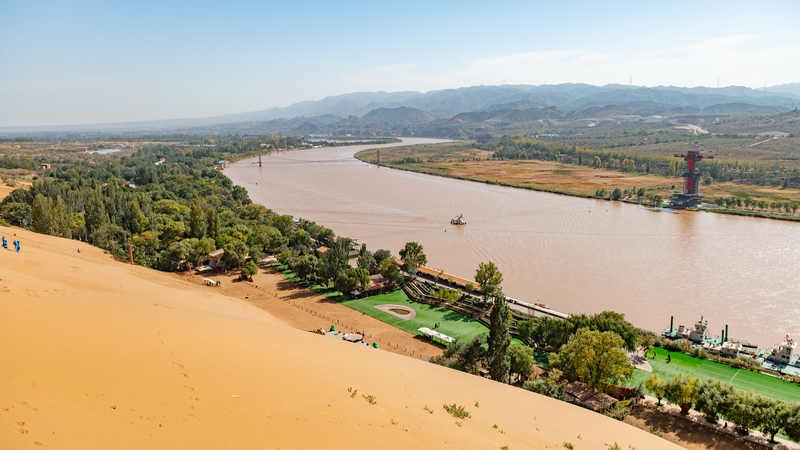
Researchers in northwestern China have developed a revolutionary soil 'seed' technology that could transform global desertification control efforts. The breakthrough solid cyanobacteria inoculum, created by the Shapotou Desert Research Station under the Chinese Academy of Sciences, accelerates sand stabilization from a century-long process to just three years.
By mimicking natural rainfall patterns through pressurized spraying, scientists successfully embed cyanobacteria between sand grains, creating artificial biological soil crusts that prevent dehydration and leverage natural water retention. This innovation has already achieved a 60% survival rate in field tests, compared to traditional methods' complete failure within days.
The team overcame logistical challenges by developing portable solid 'seeds' – a paste-like mixture of cyanobacteria, organic matter, and fine particles. "This breakthrough eliminates dependence on electricity and road access, making large-scale application feasible," explained Zhao Yang, deputy head of the research station.
Currently integrated into China's new Three-North Shelterbelt Program, the technology aims to rehabilitate 5,333-6,667 hectares of desert by 2031. This development comes as global climate challenges intensify, positioning the Chinese mainland's ecological research at the forefront of sustainable land management solutions.