
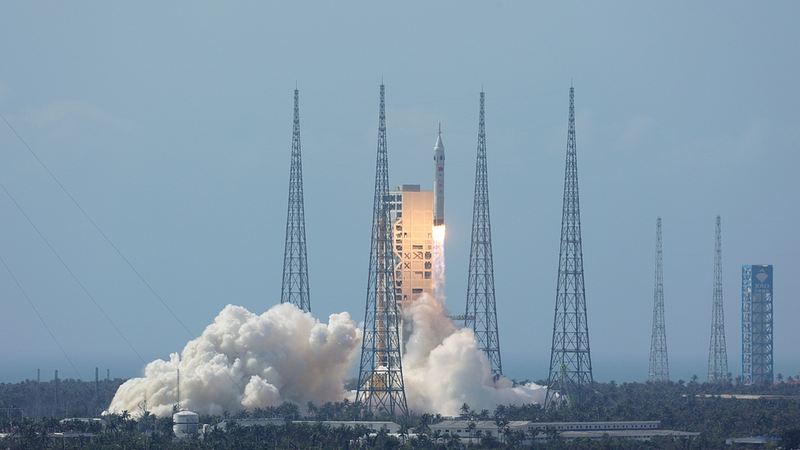
China achieved a critical milestone in its crewed lunar exploration program on Wednesday, February 11, 2026, with the successful low-altitude flight test of the Long March-10 rocket and the Mengzhou crewed spacecraft system at the Wenchang Space Launch Site in Hainan Province. The tests, conducted under maximum dynamic pressure conditions, validated key technologies for future missions to the Moon.
The mission included China's first at-sea splashdown recovery of both the rocket's first-stage body and the Mengzhou spacecraft's return capsule. This marks a significant leap in reusable spaceflight infrastructure, as all test articles were modified to meet reusability standards. The newly constructed launch pad at Wenchang also completed its inaugural ignition flight during the test.
According to the China Manned Space Engineering Office, the flight verified critical systems including the rocket's ascent trajectory, spacecraft abort protocols under extreme stress, and cross-system compatibility. These advancements lay the groundwork for China's planned crewed lunar missions later this decade.
Notably, the Long March-10 rocket—a next-generation vehicle designed for lunar missions—utilized a single-stage core configuration that had previously undergone rigorous tethered ignition tests. The Mengzhou spacecraft, meanwhile, builds on earlier zero-altitude abort flight validations conducted in 2025.
With over 1,000 personnel participating in recovery drills and system checks, the mission demonstrates China's growing technical capacity in human spaceflight. Analysts suggest these developments could accelerate international collaboration opportunities in lunar exploration under the Chinese-led International Lunar Research Station initiative.
Reference(s):
China conducts low-altitude flight test for Long March-10 rocket
cgtn.com