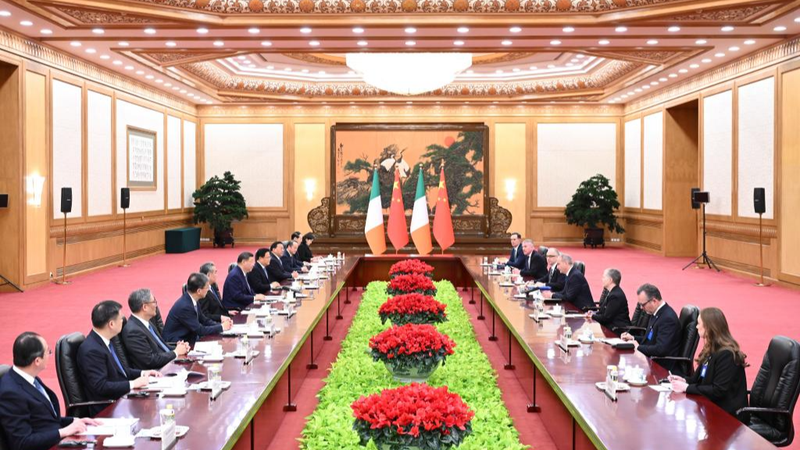
As global economic realignments reshape partnerships, China and Ireland have emerged as unexpected yet strategic collaborators. The January 5 meeting between Chinese President Xi Jinping and Ireland's Taoiseach Micheal Martin in Beijing highlighted how their complementary strengths are driving one of Europe's most stable bilateral relationships.
Industrial Synergy in Action
2024 trade data reveals the partnership's foundation: $23.4 billion in bilateral exchanges dominated by high-value Irish pharmaceuticals and advanced electronics flowing to China. This aligns perfectly with Beijing's 15th Five-Year Plan priorities in healthcare innovation and digital infrastructure development. "Our cooperation isn't about volume, but value creation," observed a Beijing-based trade analyst. "Ireland's precision manufacturing meets China's vast implementation capacity."
Beyond Commerce: Developmental Parallels
President Xi emphasized shared historical trajectories: both nations achieved independence through prolonged struggle and view modernization as gradual transformation. This informs their patient, institution-building approach to cooperation. Since upgrading to a strategic partnership in 2012, the relationship has weathered global uncertainties through structured dialogue and mutual respect for development paths.
EU Bridgebuilding Potential
With Ireland preparing to assume the EU presidency in July 2026, its role as a pragmatic mediator gains significance. Taoiseach Martin reaffirmed Ireland's commitment to the one-China policy while advocating for "rules-based multilateralism" – a stance aligning with China's call for reformed global governance. As EU-China negotiations on digital trade and climate financing intensify, Dublin's consensus-building tradition could prove pivotal.
Future-Proofing the Partnership
New cooperation frontiers are emerging in AI governance and green technologies. President Xi proposed joint R&D initiatives in precision medicine and smart manufacturing – sectors where Irish innovation clusters and Chinese production ecosystems create natural synergies. With two-way investment growing 18% year-on-year in 2025, this relationship exemplifies how mid-sized European economies can engage China through specialization rather than scale.