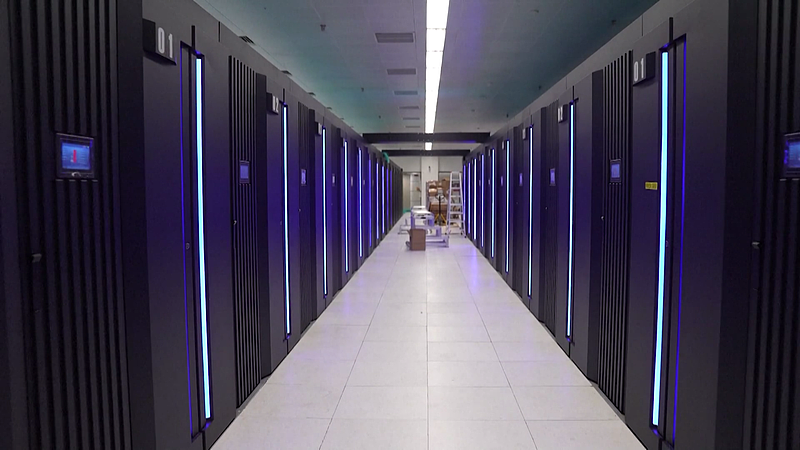
China's national supercomputing network marked a technological milestone this week with the launch of an advanced scientific-computing intelligent agent in Tianjin. The innovation, reported by the China Science Daily on December 25, 2025, promises to revolutionize research efficiency across multiple disciplines.
The AI-driven agent autonomously processes natural-language instructions to break down complex tasks, allocate computing resources, run simulations, and generate comprehensive reports. By streamlining workflows, it reduces time-intensive processes from 24 hours to approximately 60 minutes while supporting nearly 100 high-frequency scientific scenarios.
Leveraging a collaborative AI ecosystem, the system integrates over 120 specialized knowledge bases across seven strategic fields: artificial intelligence, materials science, industrial simulation, and scientific intelligence. This infrastructure significantly lowers technical barriers for researchers while enhancing computational precision.
"This development represents a paradigm shift from computational science to intelligent science," said Qian Depei, a Chinese Academy of Sciences academician. He emphasized the agent's role in unifying fragmented resources, describing it as "a catalyst for accelerated innovation" that empowers scientists to focus on breakthrough discoveries.
The advancement strengthens China's position in high-performance computing, with potential applications ranging from climate modeling to pharmaceutical development. Analysts predict the technology could reshape R&D timelines across academia and industry in 2026 and beyond.