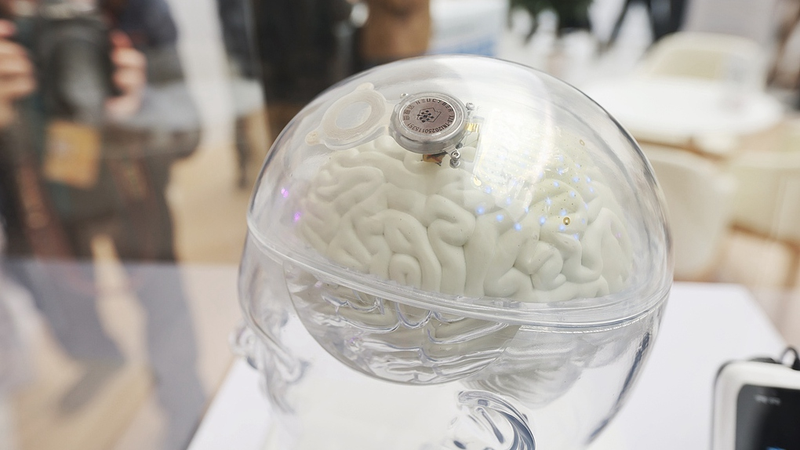
Chinese researchers have made groundbreaking progress in invasive brain-computer interface (BCI) technology, enabling paralyzed patients to perform complex real-world tasks through thought-controlled devices. A collaborative team from the Chinese Academy of Sciences Center for Excellence in Brain Science and Intelligence Technology and Shanghai's Huashan Hospital has successfully implanted ultra-thin neural electrodes – each thinner than 1% of a human hair – achieving unprecedented synchronization between brain signals and external devices.
In clinical trials this year, a quadriplegic patient demonstrated the ability to navigate outdoor environments using a mind-controlled wheelchair and command robotic assistants to complete practical tasks like food retrieval. This marks a significant leap from previous BCI applications limited to two-dimensional screen interactions.
The research team overcame four major technical challenges: developing neural data compression for 15-20% performance improvement, creating stability algorithms to filter environmental interference, implementing real-time calibration during use, and reducing system latency to under 100 milliseconds – faster than natural human neural response times.
"This transforms BCI from laboratory experiments to practical assistive technology," stated a lead researcher. A second patient has now successfully received implants, with both participants demonstrating improved quality of life through direct brain-environment interaction.
The breakthrough positions China at the forefront of neurotechnology development, with potential applications ranging from medical rehabilitation to advanced human-machine integration. Researchers emphasize ongoing work to refine the technology for broader clinical use by 2026.