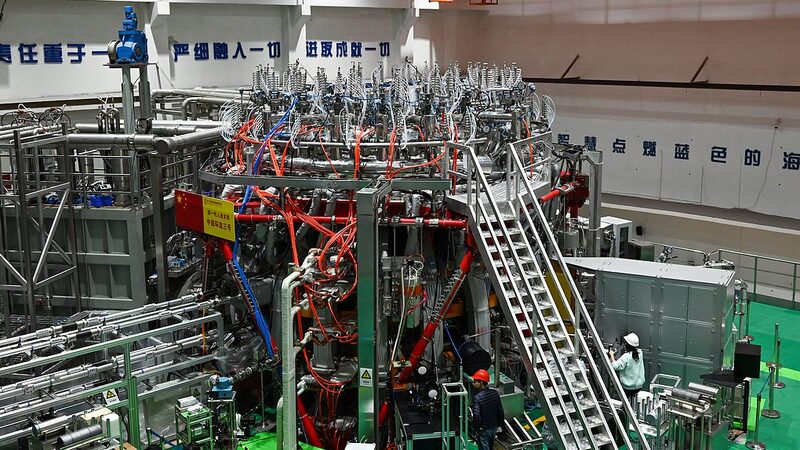
China's quest to harness fusion energy reached a critical milestone this week as policymakers outlined ambitious scientific targets under the 15th Five-Year Plan. The Experimental Advanced Superconducting Tokamak (EAST), colloquially known as China's 'artificial sun,' has achieved record-breaking plasma confinement times in 2025, bringing commercial fusion power closer to reality.
Duan Xuru, chief scientist at China National Nuclear Corporation, revealed that recent breakthroughs in magnetic confinement and materials science have accelerated progress. "We're now targeting prototype demonstration reactors by the early 2030s," Duan stated, emphasizing that fusion energy could help China meet its dual carbon goals while ensuring energy security.
The Political Bureau of the CPC Central Committee's December 9 meeting highlighted fusion research as a cornerstone of China's high-quality development strategy. This aligns with newly released recommendations prioritizing frontier technologies and ecological civilization – key themes for the 15th Five-Year Plan period (2026-2030).
International collaboration remains central to China's approach. The country continues to contribute substantially to the ITER project in France while developing domestic test reactors. Analysts suggest these parallel efforts could position China as a first-mover in commercial fusion applications, particularly in energy-intensive Asian markets.